

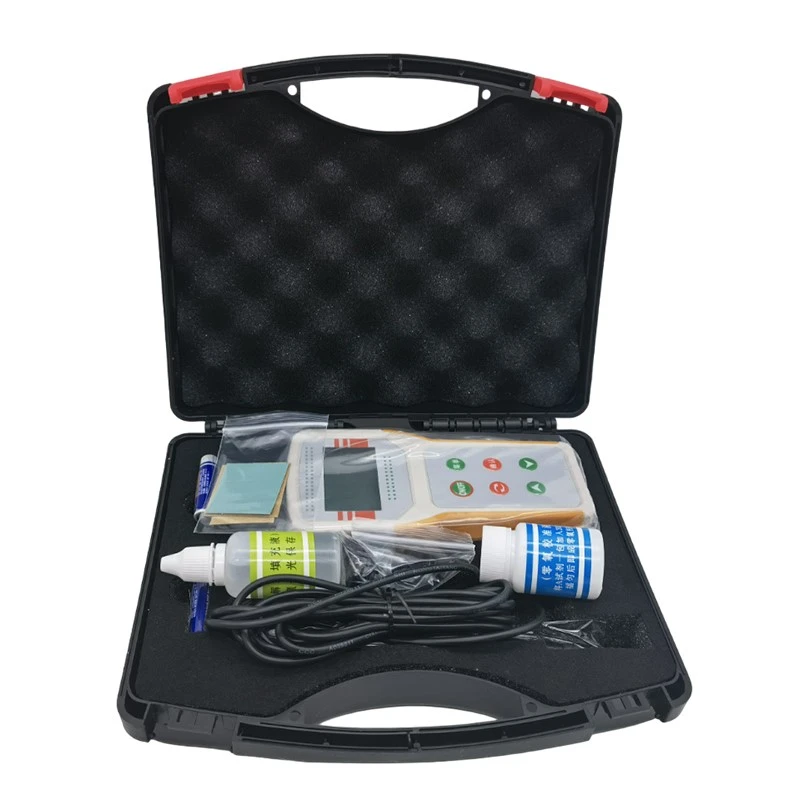
Water quality analyzer mainly uses ion selective electrode measurement method to achieve accurate detection. Electrodes on the instrument: PH, fluorine, sodium, potassium, calcium, magnesium, and reference electrode. Each electrode has an ion selective membrane, which will react with the corresponding ions in the sample to be tested. The membrane is an ion exchanger, which reacts with the ion charge and changes the membrane potential, so that the potential between the liquid, sample and membrane can be detected. The two potential differences detected on both sides of the membrane will generate current. The sample, reference electrode, and reference electrode liquid constitute one side of the "loop", and the membrane, internal electrode liquid, and internal electrode are the other side.
The ion concentration difference between the internal electrode liquid and the sample will generate an electrochemical voltage on both sides of the membrane of the working electrode. The voltage is led to the amplifier through the highly conductive internal electrode, and the reference electrode is also led to the location of the amplifier. The calibration curve is obtained by detecting a standard solution with a precise known ion concentration, thereby detecting the ion concentration in the sample.
When the ions to be measured in the solution contact the electrode, ion migration occurs in the aquifer of the ion selective electrode matrix. The charge change of the migrating ions creates an electric potential, which changes the potential between the membrane surfaces and generates a potential difference between the measuring electrode and the reference electrode.