

Hey there! As a supplier of Hydrostatic Level Gauges, I often get asked about how these nifty devices measure the level in a tank with a non - uniform cross - section. It's a pretty interesting topic, so let's dive right in!
First off, let's understand what a Hydrostatic Level Gauge is. You can check out more details about it here. A Hydrostatic Level Gauge works based on the principle of hydrostatic pressure. The basic idea is that the pressure exerted by a fluid at a certain depth is proportional to the height of the fluid column above that point. This pressure can be measured and then converted into a level reading.
In a tank with a uniform cross - section, measuring the level is relatively straightforward. The pressure at the bottom of the tank is directly related to the height of the liquid column, and we can use a simple formula (P = \rho gh), where (P) is the pressure, (\rho) is the density of the liquid, (g) is the acceleration due to gravity, and (h) is the height of the liquid column.
But things get a bit more complicated when dealing with a tank having a non - uniform cross - section. The key here is to understand that the pressure at a given point still depends on the vertical height of the liquid above it, not on the shape of the tank.
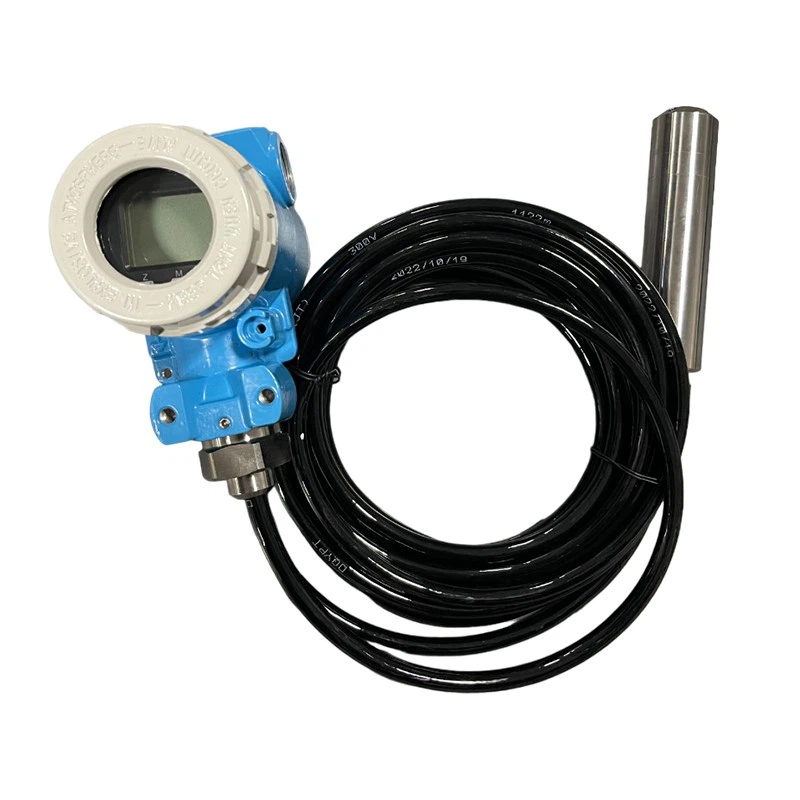

Let's say we have a tank that narrows towards the top. When we use a Hydrostatic Level Gauge, it measures the pressure at a specific location inside the tank. For instance, if we submerge a Submersible Liquid Level Sensor at the bottom of the tank, it will sense the hydrostatic pressure.
The sensor then sends this pressure data to a transmitter or a controller. The transmitter takes into account the density of the liquid (which we usually need to input based on the type of liquid in the tank) and the acceleration due to gravity. It then calculates the height of the liquid column above the sensor.
However, in a non - uniform tank, the volume of liquid corresponding to a certain height is not the same as in a uniform tank. To get an accurate volume measurement, we need to use some additional information about the tank's shape.
One way to do this is by creating a calibration curve. We can fill the tank with known volumes of liquid and record the corresponding pressure readings from the Hydrostatic Level Gauge. By plotting these data points, we can create a curve that relates pressure (or the measured height) to the volume of liquid in the tank.
For example, let's assume we have a tank that has a wide base and tapers upwards. When we start filling the tank, the pressure increases as the height of the liquid rises. But because the cross - sectional area is large at the bottom, a small increase in volume leads to a relatively small increase in height compared to the upper part of the tank where the cross - section is smaller.
We can also use advanced software solutions to handle the non - uniform tank problem. These software programs can store the geometric information of the tank, such as the cross - sectional area at different heights. When the Hydrostatic Level Gauge provides the height measurement, the software uses the stored tank geometry data to calculate the volume of the liquid in the tank accurately.
Another important aspect is the accuracy of the measurement. The accuracy of a Hydrostatic Level Gauge depends on several factors. The quality of the sensor is crucial. A high - quality Static Pressure Input Liquid Level Gauge will have a more precise pressure sensing mechanism, which leads to more accurate height and volume measurements.
Temperature can also affect the measurement. The density of the liquid changes with temperature, and since the pressure calculation depends on the density, temperature variations can introduce errors. To compensate for this, some Hydrostatic Level Gauges are equipped with temperature sensors. These sensors measure the temperature of the liquid, and the system adjusts the density value used in the pressure - to - height calculation accordingly.
Installation is also key. The Hydrostatic Level Gauge should be installed at the appropriate location in the tank. It should be submerged deep enough to get a reliable pressure reading, but not so deep that it is affected by sediment or other debris at the bottom of the tank.
Now, if you're in the market for a Hydrostatic Level Gauge to measure the level in a non - uniform tank, we've got you covered. Our Hydrostatic Level Gauges are designed with high - quality sensors and advanced technology to ensure accurate measurements. Whether you need a Submersible Liquid Level Sensor for a small tank or a more complex Static Pressure Input Liquid Level Gauge for an industrial - scale tank, we have the right product for you.
If you're interested in learning more about our products or want to discuss your specific tank measurement needs, don't hesitate to get in touch. We're here to help you find the best solution for your level measurement requirements.
References
- Principles of Fluid Mechanics textbooks
- Manufacturer's manuals for Hydrostatic Level Gauges