

In the realm of fluid measurement, transit-time ultrasonic flow meters have emerged as a reliable and efficient solution for a wide range of applications. As a leading supplier of ultrasonic flow meters, I am often asked about the flow measurement accuracy of these devices. In this blog post, I will delve into the factors that affect the accuracy of transit-time ultrasonic flow meters, discuss the typical accuracy levels achievable, and provide insights on how to optimize accuracy in real-world applications.
How Transit-Time Ultrasonic Flow Meters Work
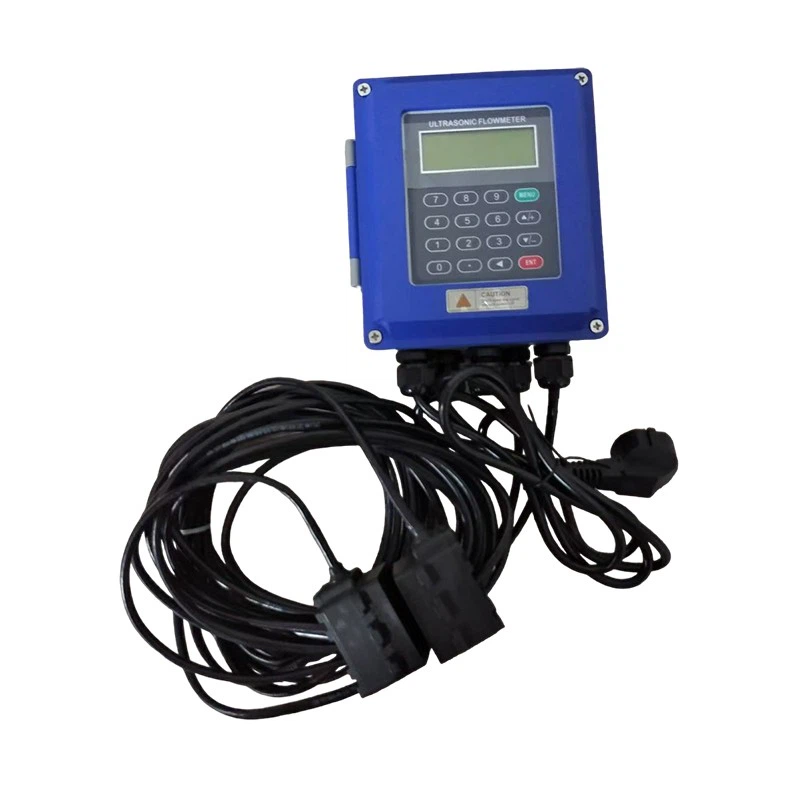
Before we dive into the accuracy aspects, let's briefly review how transit-time ultrasonic flow meters operate. These meters utilize the principle of measuring the difference in the transit time of ultrasonic signals traveling upstream and downstream in a fluid. Two ultrasonic transducers are installed on the outside of a pipe, typically at a specific angle to the pipe axis. One transducer acts as a transmitter, sending ultrasonic pulses through the fluid, while the other acts as a receiver.
The transit time of the ultrasonic signal traveling downstream (in the direction of fluid flow) is shorter than the transit time of the signal traveling upstream (against the direction of fluid flow). The difference in transit times is directly proportional to the average velocity of the fluid in the pipe. By measuring this time difference and knowing the pipe dimensions, the flow meter can calculate the volumetric flow rate of the fluid.
Factors Affecting Flow Measurement Accuracy
Several factors can influence the accuracy of transit-time ultrasonic flow meters. Understanding these factors is crucial for ensuring reliable and precise flow measurements.
Fluid Properties
The properties of the fluid being measured play a significant role in the accuracy of ultrasonic flow meters. Fluids with high levels of suspended solids, bubbles, or contaminants can scatter or absorb the ultrasonic signals, leading to inaccurate measurements. For example, in wastewater applications where the fluid contains a large amount of debris, the ultrasonic signals may be attenuated or reflected, causing errors in the transit time measurements.
The viscosity of the fluid can also affect the accuracy of the flow meter. Highly viscous fluids can cause the flow profile in the pipe to deviate from the ideal laminar or turbulent flow conditions assumed by the flow meter's calibration. This can result in inaccurate velocity measurements and, consequently, inaccurate flow rate calculations.
Pipe Conditions
The condition of the pipe in which the flow meter is installed can have a significant impact on measurement accuracy. Pipes with rough inner surfaces, corrosion, or scale buildup can cause the ultrasonic signals to scatter or reflect, leading to errors in the transit time measurements. Additionally, pipes with non-uniform cross-sectional areas or bends can disrupt the flow profile, affecting the accuracy of the flow meter.
The diameter and wall thickness of the pipe are also important considerations. Transit-time ultrasonic flow meters are typically calibrated for specific pipe sizes and wall thicknesses. Installing the flow meter on a pipe with different dimensions than those specified in the calibration can result in inaccurate measurements.
Installation Location
The location of the flow meter within the pipe system can affect its accuracy. Ideally, the flow meter should be installed in a straight section of pipe with sufficient upstream and downstream straight runs to ensure a fully developed flow profile. Upstream disturbances such as valves, elbows, or tees can cause the flow to become turbulent or non-uniform, leading to inaccurate velocity measurements.
The orientation of the flow meter can also be important. For some applications, the flow meter may need to be installed horizontally or vertically to ensure proper operation. Incorrect orientation can cause the ultrasonic signals to be affected by gravity or air pockets, leading to measurement errors.
Temperature and Pressure
Changes in temperature and pressure can affect the properties of the fluid and the ultrasonic signals, leading to errors in the flow measurements. For example, an increase in temperature can cause the fluid to expand, changing its density and viscosity. This can affect the velocity of the ultrasonic signals and the flow profile in the pipe, resulting in inaccurate flow rate calculations.
Similarly, changes in pressure can affect the density and compressibility of the fluid, which can also impact the accuracy of the flow meter. In high-pressure applications, the pressure can cause the pipe to deform slightly, affecting the alignment of the ultrasonic transducers and the accuracy of the transit time measurements.
Typical Accuracy Levels
The accuracy of transit-time ultrasonic flow meters can vary depending on the specific model, application, and operating conditions. In general, these flow meters can achieve accuracies of ±0.5% to ±2% of the measured flow rate under ideal conditions. However, in real-world applications, the accuracy may be lower due to the factors discussed above.
For example, in applications where the fluid contains a small amount of suspended solids or bubbles, the accuracy of the flow meter may be reduced to ±2% to ±5%. In applications with more challenging fluid conditions or pipe configurations, the accuracy may be even lower.
It's important to note that the accuracy of the flow meter is typically specified at a certain flow rate range. Outside of this range, the accuracy may degrade. For example, a flow meter may have an accuracy of ±1% at flow rates between 10% and 100% of its full scale, but the accuracy may increase to ±2% or more at flow rates below 10% of the full scale.
Optimizing Flow Measurement Accuracy
To achieve the highest possible accuracy with transit-time ultrasonic flow meters, several steps can be taken to minimize the effects of the factors discussed above.
Fluid Conditioning
In applications where the fluid contains suspended solids, bubbles, or contaminants, it may be necessary to condition the fluid before it reaches the flow meter. This can involve using filters, separators, or degassers to remove the unwanted particles or bubbles from the fluid. By ensuring a clean and homogeneous fluid, the ultrasonic signals can travel more freely through the fluid, reducing the likelihood of measurement errors.
Pipe Preparation
Before installing the flow meter, it's important to prepare the pipe to ensure optimal performance. This may involve cleaning the inner surface of the pipe to remove any corrosion, scale, or debris. If the pipe has a rough inner surface, it may be necessary to use a lining or coating to smooth the surface and improve the transmission of the ultrasonic signals.

Proper Installation
Proper installation of the flow meter is crucial for ensuring accurate measurements. The flow meter should be installed in a straight section of pipe with sufficient upstream and downstream straight runs. The upstream straight run should typically be at least 10 to 20 times the pipe diameter, while the downstream straight run should be at least 5 times the pipe diameter.
The flow meter should also be installed in the correct orientation, as specified by the manufacturer. The ultrasonic transducers should be properly aligned and tightened to ensure good contact with the pipe surface.
Regular Maintenance and Calibration
Regular maintenance and calibration of the flow meter are essential for maintaining its accuracy over time. The flow meter should be inspected periodically for any signs of damage or wear, and the ultrasonic transducers should be cleaned to remove any dirt or debris.
Calibration should be performed at regular intervals to ensure that the flow meter is providing accurate measurements. The calibration process typically involves comparing the flow meter's readings to a known reference flow rate. If any discrepancies are found, the flow meter can be adjusted or recalibrated to correct the measurements.
Our Ultrasonic Flow Meter Solutions
As a leading supplier of ultrasonic flow meters, we offer a wide range of products designed to meet the diverse needs of our customers. Our Bi Directional Ultrasonic Flow Meter is suitable for applications where the fluid flow can be in either direction, providing accurate measurements in both forward and reverse flow conditions.
Our Fixed Ultrasonic Flow Meter is designed for permanent installation in industrial applications, offering high accuracy and reliability. It is available in a variety of configurations to suit different pipe sizes and fluid types.
For portable and on-the-go applications, we offer the Hand Held Ultrasonic Flow Meter. This compact and lightweight flow meter is easy to use and can be quickly installed on pipes without the need for cutting or welding.
Contact Us for Your Flow Measurement Needs
If you are looking for a reliable and accurate ultrasonic flow meter for your application, we are here to help. Our team of experts can provide you with detailed information about our products, assist you in selecting the right flow meter for your needs, and offer technical support and calibration services.
Contact us today to discuss your flow measurement requirements and learn more about how our ultrasonic flow meters can help you achieve accurate and reliable flow measurements.
References
- ISO 11631:1998 - Measurement of fluid flow in closed conduits - Ultrasonic transit-time meters for liquid flow.
- American Petroleum Institute (API) - Manual of Petroleum Measurement Standards (MPMS), Chapter 5 - Flow Measurement.
- ASME MFC-5M-2004 - Measurement of Fluid Flow in Closed Conduits Using Transit-Time Ultrasonic Flow Meters.