

The Submersible Level Gauge, also referred to as a level sensor or level transmitter, is submerged directly in the liquid to be measured and positioned as close as possible to the bottom. There, the submersible pressure sensor measures the hydrostatic pressure, which enables a direct conclusion regarding the current level, i.e. the height of the liquid column above it

Why choose us
01
Our Product
We offer a range of products, including ultrasonic liquid level meters, electromagnetic flow meters, open channel flow meters, and online water quality analyzers. Our analyzers include online pH meters, dissolved oxygen meters, conductivity meters, turbidity meters, sludge concentration meters, and sludge interface meters. Additionally, we provide pressure transmitters and input level gauges.
02
Product Application
Dongyi is a high-tech company that manufactures industrial instruments. Our products are used in many fields, such as environmental protection, chemical processing, printing and dyeing, pharmaceuticals, water treatment, municipal engineering, and tap water systems.
03
Our Certificates
We hold several certifications, including utility model patents, design patents, software works, and quality management system certifications.
04
Production Equipment
Our production facilities are equipped with advanced tools, including ultrasonic and radar testing devices, laser welding equipment, flow calibration devices, pressure debugging equipment, high and low temperature aging boxes, and circuit aging devices.


Advantages of Submersible Level Gauge
1.Its full degree, zero long-term stability up to 0.2%FS/ year.In the range of compensation temperature 0 ~ 70 ℃, the temperature drift is less than 0.1%FS, and less than 0.3%FS in the whole allowable operating temperature range.
2.With reverse protection and current limiting protection circuit, the positive and negative connection will not damage the transmitter during installation, and the transmitter will automatically limit the current within 35MA when abnormal.
3.Its solid structure has strong reliability and long service life.
4.Easy installation, simple structure, economical and durable.
How to Use Submersible Level Sensors
Once installed, connect the sensor's wiring to the controller or data logger. This will enable you to collect and analyze data from the sensor. And before using the sensor, calibrate it to ensure accurate readings. Follow the manufacturer's instructions for calibration and adjust the sensor as needed. Set up alarms to notify us when the tank reaches certain levels. This will help prevent overflows or runouts, and ensure the tank is refilled as needed. The data collected from the sensor can be analyzed to understand the liquid level trends in the tank.
And note to regularly check and maintain the submersible level sensor to ensure it continues to provide accurate readings. Replace the sensor as needed.
What’s the Use of a Submersible Level Gauge in Water?
Submersible pressure transducers are versatile devices used in various water-related applications to provide accurate and reliable measurements. Here are some of their key uses:
Water Level Measurement
These transducers are ideal for measuring water levels in natural bodies of water, such as rivers, lakes, and channels. They provide precise readings of water pressure at different depths, enabling the calculation of water levels.
01
Tank Level Monitoring
In both industrial and agricultural settings, submersible pressure transducers are employed to monitor liquid levels in tanks, including water, fuel, and chemicals. This helps in effective resource management and prevents spills or leaks.
02
Groundwater Monitoring
These devices are crucial for monitoring groundwater levels in aquifers and measuring water pressure in wells. The data collected can be used to assess groundwater availability and sustainability.
03
Environmental Monitoring
Submersible pressure transducers play a role in environmental monitoring by measuring water quality indicators, such as dissolved oxygen levels. They also track changes in water pressure due to variations in temperature or salinity, helping to detect environmental changes and potential pollution sources.
04
Oceanography
In oceanographic research, these transducers are used to measure seawater pressure at various depths. This data is valuable for studying ocean currents, tides, and waves, as well as monitoring changes in ocean temperature and salinity.
05
How They Work
But how do submersible level sensors work? Submersible level transmitters consist of a sensor attached to a long cable, which is then lowered to the bottom of the liquid vessel. The sensor operates by measuring the hydrostatic pressure of the liquid medium. Also known as the head pressure, hydrostatic pressure is the pressure exerted by the fluid in the vessel. The level of hydrostatic pressure as measured by the sensor is determined by two things: the density of the liquid and its height. With liquid density remaining constant, changes in hydrostatic pressure necessarily reflect a difference in the liquid level.
Of course, nothing occurs in a vacuum – Especially not pressure sensing. Atmospheric conditions affecting barometric pressure above the liquid line affect the hydrostatic pressure at the bottom of the vessel as well as liquid levels. Invented or non-pressurized vessel applications where atmospheric pressure is subject to change, submersible level sensors are therefore equipped with venting to compensate, maintaining the integrity of the hydrostatic pressure readings.
The compact, sophisticated nature of the sensor unit, along with the possibility of cable lengths up to 2,500 feet in special situations, makes submersible level sensors particularly versatile. Common applications include freshwater pump controls in wells and deep wells, accurate hydrometry readings for sea or surface water levels, pump control at wastewater treatment plants, and other water treatment, retention, and usage fields.
Considerations to take before installation

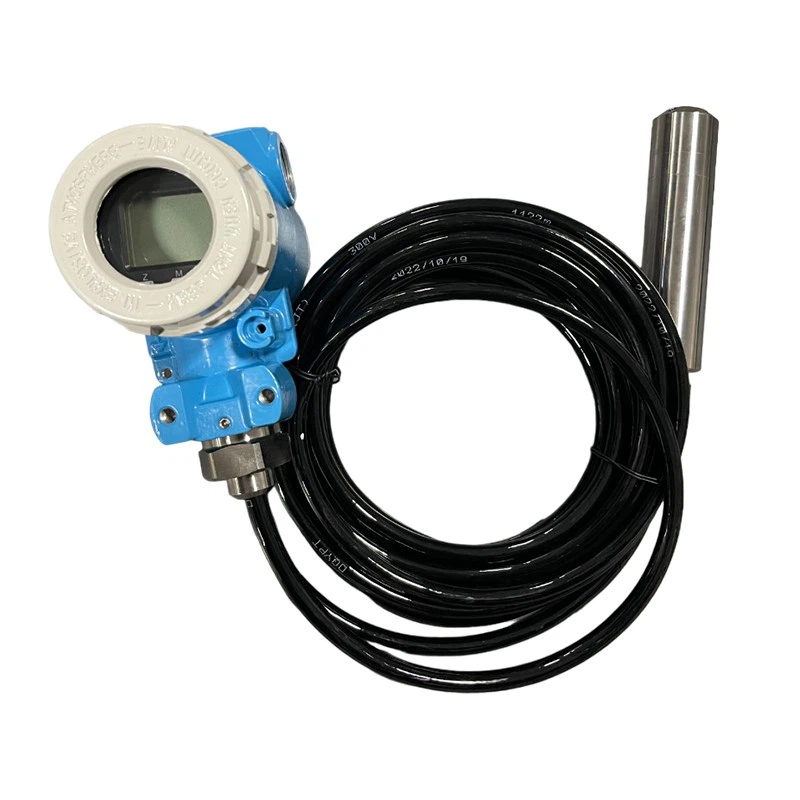
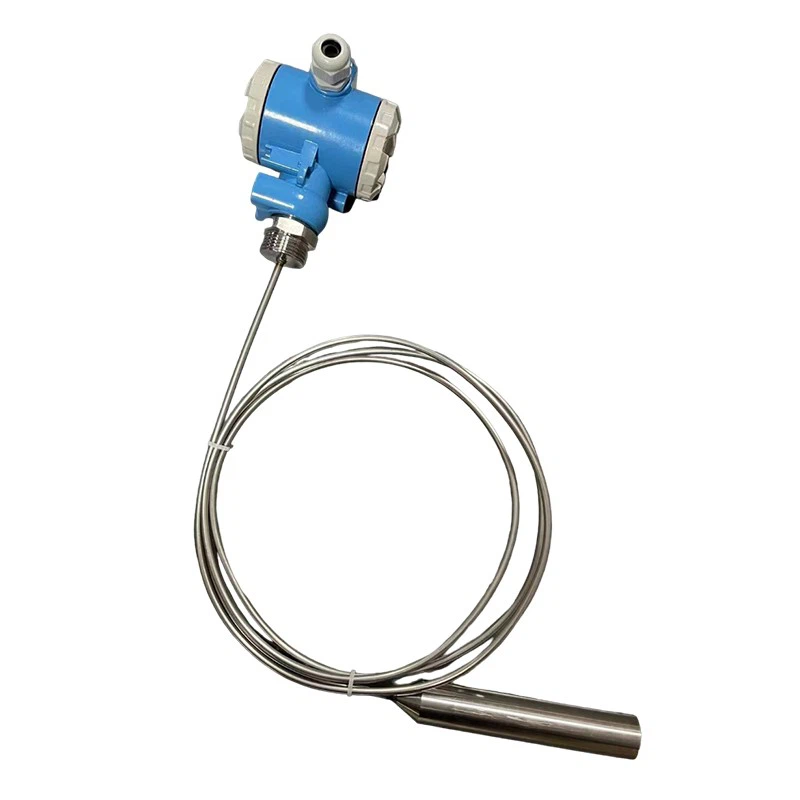

Before installation, make sure that:
● The static pressure produced by the liquid at the installation site does not exceed the Full-Scale range of the transmitter.
● The measurement liquid is compatible with the transmitter material of construction.
● While mounting the transmitter, avoid areas subject to electrical noise, excessive vibration, and radiant heat.
Installation methods:
● Insert the transmitter vertically downwards into the measurement container.
● Make sure the transmitter is completely submerged in the liquid for the best accuracy.
● Ensure that the measurement liquid is compatible with the transmitter’s material of construction.
● Make sure that the holes in the protection cap are not blocked by particles suspended in the measurement liquid.
● Installation in the static liquid. Stilling well tube is used to avoid disturbance to the sensing part for both static and flowing liquids.
Types of Submersible Level Gauge
There are various types of submersible level transmitters available in the market, each suitable for specific applications. Some common types include:
1. Traditional Submersible Level Transmitters: These are the most basic type, typically used for general level measurement in tanks and reservoirs.
2. Submersible Level Transmitters with Vent Tubes: Suitable for applications where the liquid being measured generates corrosive vapors or high temperatures.
3. Intrinsically Safe Submersible Level Transmitters: Designed for hazardous environments where the presence of flammable gases or dust is expected.
4. Submersible Level Transmitters with Multiple Outputs: These devices offer multiple output options, such as analog, digital, or wireless, providing flexibility in data transmission.
5. Submersible Level Transmitters with Options for Remote Monitoring: These transmitters come with built-in communication capabilities, allowing remote monitoring and control of liquid levels.

Maintenance Tips for Submersible Level Gauges
Below are maintenance tips for submersible level transmitters:
Regular Cleaning: Ensure regular cleaning of the level transmitter to maintain accurate measurements.
Careful Removal: When cleaning, first open the screw cap of the iron pipe of the drop-in level transmitter and carefully remove the level transmitter. Then, remove any debris attached to it (such as aquatic plants or plankton).
Cleaning the Pressure Hole: To clean the pressure hole of the level transmitter, inject trichlorethylene or alcohol into the hole to half its height and let it soak for about 5 minutes. Gently shake it and repeat this process several times until clean. Avoid using any utensils to clean the pressure hole, as this could damage the pressure diaphragm of the sensitive core.
Avoid Hard Tools: When cleaning the pressure port and pressure hole of the transmitter, avoid using brushes or metal tools that are too hard, as they may damage the sensitive core and the threads of the pressure port.
Reinstallation: After cleaning, slowly reinsert the level transmitter back into the iron pipe, ensuring it is seated properly at the bottom. Then, reinstall the screw cap in its original position. After dismounting, cleaning, and reinstalling, the installation depth may change slightly, so the detection value of the secondary instrument must be recalibrated by referring to the level transmitter at the same water level of the sluice. This ensures the accuracy of the sampling data.
Our Factory
Zhejiang Dongyi Technology Co., Ltd. was formerly known as Hangzhou Tuosheng Automation Instrument Co., Ltd. "TUOSHENG" was founded in 2010. It has been deeply involved in the industrial instrument industry for more than ten years and has profound technical accumulation. Dongyi Company was built by the original team of "Tuosheng" and its headquarters is located in the beautiful paradise on earth - Hangzhou, Zhejiang. In 2023, the company began to prepare for international cross-border business, and registered and established Hangzhou Dongyi Import and Export Co., Ltd. in 2024 to enter the international market.


FAQ
We're well-known as one of the leading submersible level gauge manufacturers and suppliers in China. Please feel free to buy high quality submersible level gauge made in China here from our factory. Contact us for customized service.
Hydrostatic Level Gauge, submersible level gauge, Static Pressure Input Liquid Level Gauge